
The Ultimate Guide to N12 Evictions and L2 Applications in Ontario: Part 2

The following is not and should not be construed as legal advice. As of July 1, 2026, our firm is no longer accepting new clients for housing-related cases. If you are interested in keeping up with our work (including posts like this one), subscribe to the Green Economy Law Monthly Newsletter here.
In this second installment of our Ultimate Guide to N12 Evictions and L2 Applications in Ontario, we review the next step of the eviction process: the L2 eviction application and its submission to the Landlord and Tenant Board (LTB).
Below, you’ll find instructions on how to correctly fill out and file the L2 if you’re a landlord. And for tenants, we’ll cover technical and procedural grounds for defeating an L2. In addition to reading this guide, both landlords and tenants should review the LTB’s own instructions for how to submit an L2 application.
What is an L2?
An L2 is the application that a landlord files with the LTB to request a hearing in view of evicting a tenant for reasons other than non-payment of rent. Once the L2 is submitted, a hearing will be scheduled to determine whether or not the eviction application should be granted.
You can find the PDF application here; but you’re better off logging into the LTB Portal, filling it out there, and submitting it online.
Due to the LTB’s extensive case backlog, it may take several months for a hearing to be scheduled after an application is filed.
How to complete an L2
The main things to remember when filling out and submitting the L2 application are:
Names and Addresses: Provided you have filled out the N12 correctly, simply ensure that the tenant and landlord names, and addresses, all match up. Don’t complicate or mess up your application by entering inconsistent information. This is actually a common issue.
Other N12 or N13s: If you have served any tenants, in any property you own, N12s or N13s in the last two (2) years – even if the notices were never acted on or followed up by an L2 application – ensure you provide all relevant details for every single notice. Failure to provide this information may result in your L2 application being dismissed.
And if you messed this up upon filing, you should submit a request to amend your application as soon as possible. This can be done by simply submitting a letter in the LTB portal requesting that the application be amended accordingly - there is no official LTB application amendment form. At the hearing, raise the amendment as a preliminary issue and point to the prior letter submission, since the LTB technically has to ‘grant’ the amendment at the hearing.
Declaration: The person who intends to reside at the rental unit must sign a declaration or affidavit saying that they, in good faith, require the rental unit for their own use for at least a year. Though some write lengthy explanations of why they want to occupy the unit, keeping things as simple as possible - and sticking more or less with what we’ve emphasized in bold above - is recommended. You just want to meet the LTB requirements without giving the other side more to pick apart.
And notwithstanding that s. 71.1 says an affidavit is required, pursuant to s. 192.1, a declaration will suffice. Declarations are easier to use since they do not need to be witnessed and signed by a commissioner of oaths or anyone else. Note, however, that the declaration (or affidavit) must be signed by the person intending to reside in the unit. It cannot be signed by anyone else on their behalf.
If your N12 indicates multiple people intend to reside in the unit, the safest thing to do is have all of those people sign separate declarations. These should all be submitted with the L2. Though as we wrote in Part 1 of this guide, it’s recommended that you only identify one intended occupant, even if that occupant will bring family members or others to live with them.
If you submitted your L2 without the requisite declaration(s), submit the declaration(s) as soon as possible before your hearing. Pursuant to s. 190, the LTB can extend the deadline for declaration/affidavit submission, but whether they actually do is left to the LTB member’s individual discretion.
How to Submit an L2?
Before you submit your application, make sure that the N12 notice has been properly served on your tenants. We covered this subject in Part 1 of this guide.
Once the N12 is served, you can submit your L2 application to the LTB. You don’t have to wait until the termination date. And if you don’t think that the tenants will move out voluntarily (i.e., without a hearing) and you want the hearing to be scheduled as soon as possible, it makes sense to submit as soon as possible.
But if the tenants vacate without a hearing, and you have to withdraw the application, you won’t be able to recover the application fee. Tenants cannot be liable for it, even if you succeed with an L2 application. Nor can they be held liable for anything if they simply refuse to comply with an N12, as it’s their legal right to challenge it.
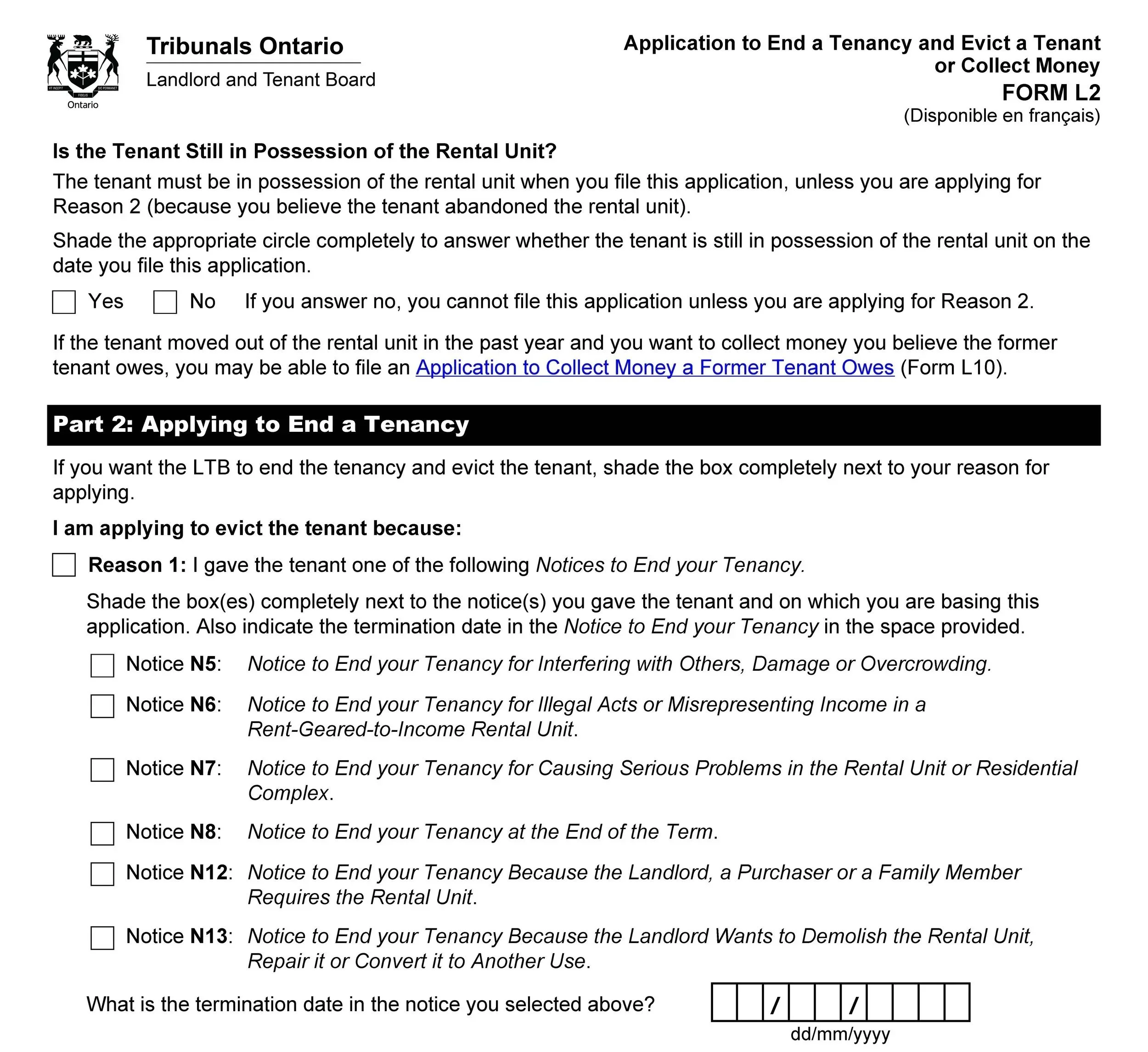
An excerpt of the L2 application form. The full LTB form can be found here.
The easiest way to submit an L2 is through the LTB’s Online Portal. To do this, you must sign into your My Ontario Account; if you don’t have an account, you can create one using your email address or through a trusted intermediary, like a bank. Alternatively, you can send in your application by email or by mail or courier.
Whichever method you choose, make sure to include:
A copy of the N12 form you served on the tenants;
An certificate of service confirming when you served it (which should be filled out quickly after service); and
The declaration (or affidavit) from the intended occupant.
If, between serving the N12 and submitting the L2, you paid the tenant(s) their requisite one month’s compensation, you may wish to submit proof of payment along with the L2 application. Similarly, if you provided a letter waiving rent of one month prior to the termination date in the N12 (or arrears owing), you may wish to submit proof of that waiver with the L2 application.
While our firm is no longer accepting new clients for housing-related cases, those seeking legal representation for housing matters can check out our paralegal referrals page.